
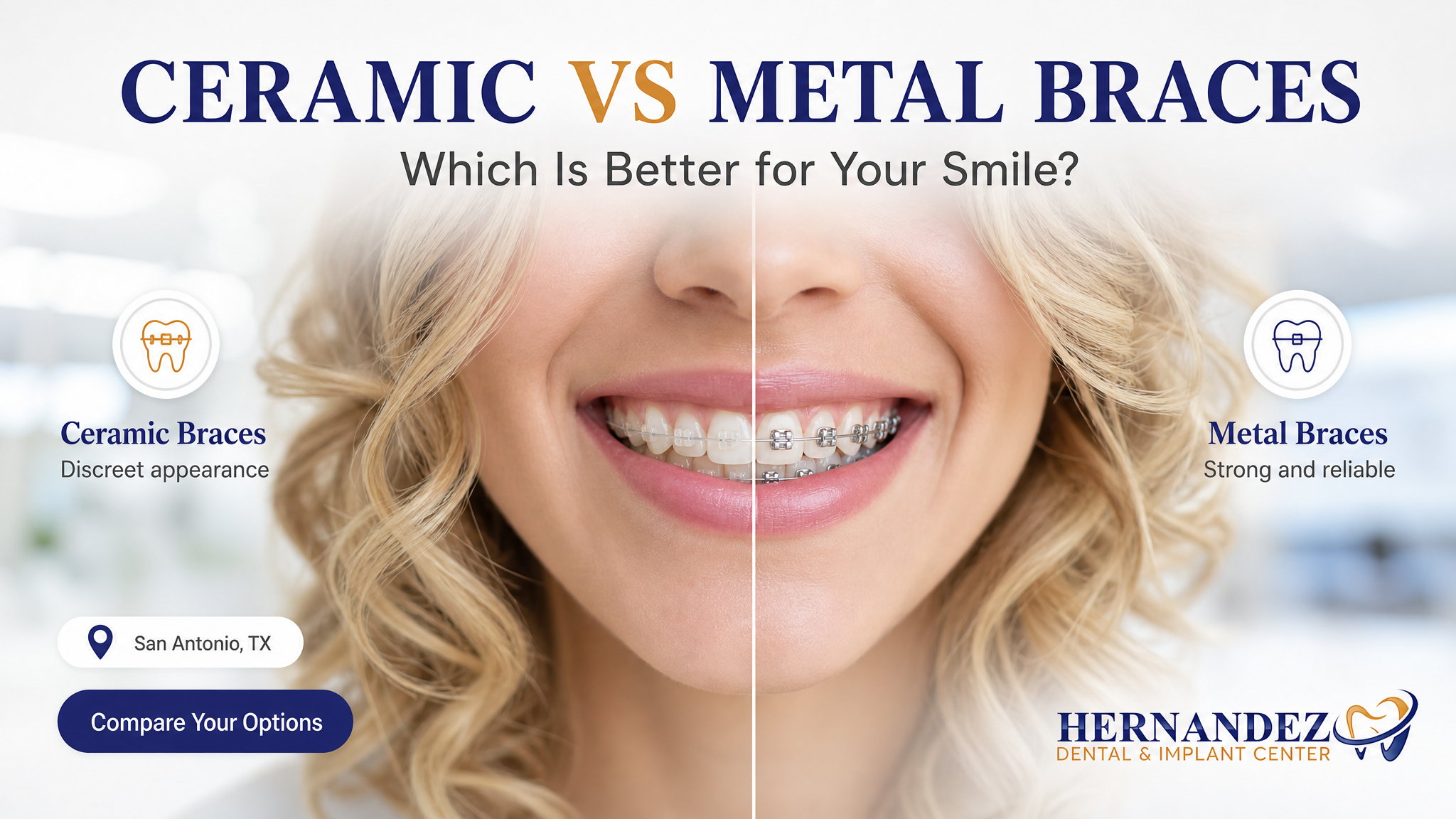
Choosing between ceramic and metal braces usually comes down to four priorities: appearance, durability, maintenance and cost.
Both types of braces use brackets and archwires to gradually move teeth into healthier positions. Ceramic braces use clear or tooth-colored brackets that blend with your smile, while traditional braces use highly durable metal brackets. Ceramic braces may appeal to patients who want a less noticeable treatment, while metal braces may be better for patients prioritizing strength, affordability and versatility.
However, neither option is automatically better for every patient. The right choice depends on your bite, the complexity of tooth movement, your lifestyle and your treatment goals.
At Hernandez Dental & Implant Center, we help patients explore braces and orthodontic treatment options in San Antonio based on their individual needs.
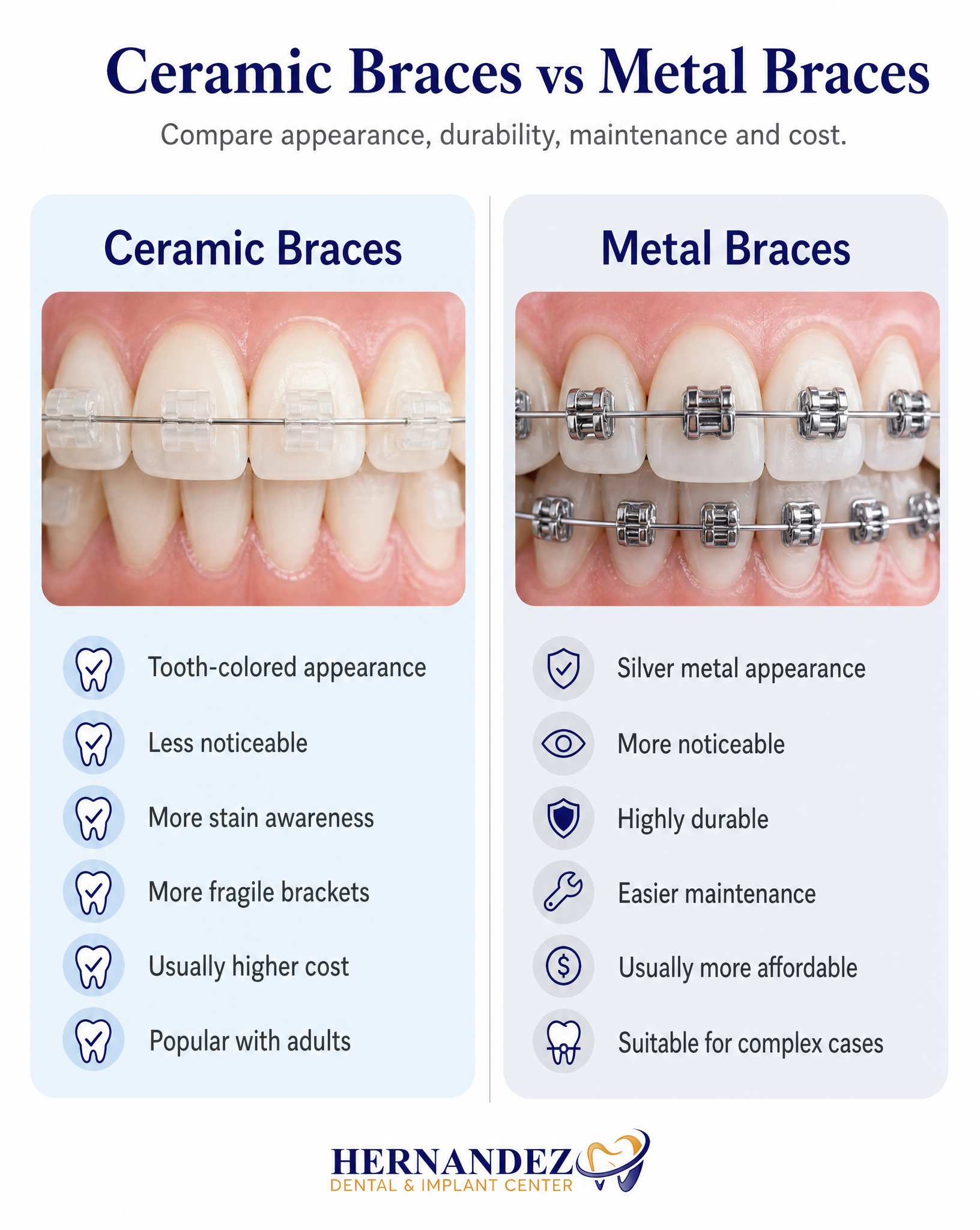
Ceramic Braces vs Metal Braces at a Glance
| Feature | Ceramic braces | Metal braces |
|---|---|---|
| Appearance | Clear or tooth-colored and less noticeable | Silver-colored and more visible |
| Materials | Ceramic or porcelain brackets | High-grade stainless steel brackets |
| Durability | Effective but more fragile | Strong and highly durable |
| Maintenance | Requires careful cleaning and stain prevention | Generally easier to maintain |
| Cost | Usually more expensive | Usually more affordable |
| Treatment capability | Suitable for many orthodontic conditions | Suitable for a broad range of simple and complex cases |
| Repairs | Brackets may be more likely to chip or break | Lower risk of bracket breakage |
| Best suited for | Patients who prioritize discretion | Patients who prioritize strength and value |
This comparison provides a general overview. Your dentist must examine your teeth and bite before confirming whether ceramic or metal braces are suitable for you.
How Do Ceramic and Metal Braces Work?
Ceramic and metal braces work according to the same basic principle.
Small brackets are bonded to the front of the teeth. An archwire passes through the brackets and applies controlled pressure. During regular appointments, the wire or other components may be adjusted so that the teeth gradually move toward their planned positions.
The main difference is the bracket material.
Traditional braces normally use stainless steel brackets and metal wires. Ceramic braces use clear or tooth-colored brackets and may be paired with less noticeable wires and elastic ties. Although ceramic braces blend more naturally with the teeth, they are still visible at close range.
Both systems may be used to address orthodontic concerns such as:
- Crowded or overlapping teeth
- Gaps between teeth
- Crooked teeth
- Overbites
- Underbites
- Crossbites
- Open bites
- Other forms of bite misalignment
Clear ceramic braces can correct many of the same orthodontic issues as metal braces, but they may not be recommended for every patient or every type of tooth movement.
Which Braces Are Less Noticeable?
Ceramic braces are the less noticeable option.
Their brackets are designed to match or complement the natural color of your teeth. This makes them popular among adults, college students, older teenagers and professionals who want fixed braces without the prominent metallic appearance.
Ceramic braces may be especially appealing when you:
- Regularly attend meetings or professional events
- Speak in front of clients or audiences
- Frequently appear in photographs
- Want fixed braces but prefer a more discreet appearance
- Do not want to manage removable aligners
Metal braces are more visible, although modern brackets are generally smaller and more streamlined than many older designs. Some patients also enjoy personalizing metal braces with colored elastic ties.
Ceramic braces are not invisible. The brackets, archwire and elastic ties may still be noticeable when someone looks closely. Nevertheless, the tooth-colored components generally make them less prominent than traditional metal braces.
Appearance winner: Ceramic braces
Which Option Is More Durable?
Metal braces generally offer greater durability.
Metal brackets are made to withstand the forces involved in orthodontic treatment. Their strength makes them a reliable option for many different tooth movements and bite corrections.
Ceramic brackets are strong enough for many orthodontic cases, but the material is more brittle than metal. A ceramic bracket may be more likely to crack, chip or break when exposed to hard foods, direct impact or excessive pressure.
Patients with ceramic braces should be especially careful with:
- Hard candy
- Ice
- Nuts
- Popcorn kernels
- Sticky or chewy candy
- Biting directly into hard fruits or vegetables
- Pens, fingernails and other nonfood objects
Broken brackets can interrupt treatment and may require an additional repair appointment. Depending on the clinic’s policies and treatment agreement, repairs may also affect the overall cost.
Metal braces may therefore be more suitable for patients who want the strongest available bracket material or who are concerned about maintaining ceramic brackets.
Durability winner: Metal braces
Are Ceramic Braces More Comfortable?
Neither option is guaranteed to be more comfortable for every patient.
Ceramic and metal braces use similar brackets and wires to place pressure on the teeth. Because the mechanics are similar, both can cause temporary soreness after the braces are first placed and following certain adjustment appointments.
Some patients feel that ceramic brackets are smoother against their cheeks, while others prefer the smaller profile of certain metal brackets. Comfort can depend on:
- The bracket design
- The position of the brackets
- Individual mouth sensitivity
- The orthodontic movements being performed
- Whether a wire or bracket irritates the cheek
- How recently the braces were adjusted
Mild tenderness is common during the first few days after braces are placed. Orthodontic wax and soft foods may help while your mouth adjusts. Contact your dental provider when a wire is sharply irritating your mouth, a bracket becomes loose or discomfort does not improve as expected.
Comfort winner: Depends on the patient and bracket system
Which Braces Work Faster?
Metal braces are not automatically faster in every case, and ceramic braces do not always take longer.
Treatment time is influenced more strongly by factors such as:
- The severity of crowding or spacing
- The type of bite problem
- The amount of tooth movement required
- The health of the teeth and gums
- Broken or loose brackets
- Attendance at scheduled appointments
- Following food and care instructions
- Wearing elastics as directed
The Cleveland Clinic notes that braces treatment averages about two years overall, although some patients finish in less than 12 months and others require up to three years. It also notes that ceramic braces may sometimes take slightly longer because the brackets are more fragile.
Metal braces may be recommended when a treatment plan requires greater durability or when the provider wants to reduce the risk of bracket damage. Ceramic braces can still deliver effective results when they are appropriate for the patient’s case and cared for properly.
Your estimated treatment time should be based on an individual orthodontic evaluation rather than the color or material of the brackets alone.
Treatment-time winner: Depends on the case, although metal braces may provide practical advantages in some complex treatments
Ceramic vs Metal Braces Cost in San Antonio
Metal braces are generally the more affordable option, while ceramic braces usually cost other Country more because of their materials and aesthetic design. Ceramic bracket repairs may also add expenses when they are not included in the treatment agreement.
The total cost of braces in San Antonio can depend on:
Treatment complexity
Minor spacing may require a different treatment plan than severe crowding, jaw misalignment or a complicated bite problem.
Length of treatment
Longer treatment may involve more appointments, adjustments and clinical monitoring.
Diagnostic records
Your treatment evaluation may include photographs, impressions, digital scans or dental X-rays. Dental X-rays help providers view tooth roots, jawbones and structures that cannot be fully evaluated during a visual examination. They can also support braces treatment planning.
Bracket type
Ceramic brackets generally cost more than conventional metal brackets.
Repairs and replacement parts
Broken ceramic brackets may require replacement. Ask whether repairs are included in your treatment fee or charged separately.
Insurance benefits
Dental insurance coverage for orthodontics varies by plan. Some policies cover part of the treatment, while others limit benefits by age, treatment type or lifetime orthodontic maximum.
Payment arrangements
Before beginning treatment, ask the clinic for a written estimate explaining what is included. You can also ask whether payment plans or financing arrangements are available.
Hernandez Dental & Implant Center promotes affordable braces and orthodontic treatment in San Antonio, but an examination is necessary to determine your individual treatment needs and exact cost.
Which Braces Are Easier to Maintain?
Both ceramic and metal braces require consistent brushing, flossing and professional dental care.
Plaque and food particles can collect around brackets and beneath wires. Without proper cleaning, patients may be at greater risk of tooth decay, gum inflammation and visible marks around the brackets.
Metal braces usually have fewer cosmetic staining concerns. Ceramic brackets are designed to remain attractive, but clear or tooth-colored components—particularly elastic ties—may discolor over time.
Darkly pigmented foods and drinks that may contribute to discoloration include:
- Coffee
- Tea
- Red wine
- Tomato-based sauces
- Dark sodas
- Strongly colored sauces
You do not necessarily have to eliminate every staining food. Rinsing with water after eating, brushing carefully and attending scheduled appointments can help maintain the appearance of your braces.
For both types of braces:
- Brush after meals when possible.
- Clean carefully around each bracket.
- Use floss threaders, interdental brushes or other recommended tools.
- Avoid hard, sticky and excessively chewy foods.
- Do not miss adjustment appointments.
- Schedule regular dental examinations and cleanings.
Ceramic braces may require more attention to appearance and staining, while metal braces are generally more forgiving.
Maintenance winner: Metal braces
Who Should Choose Ceramic Braces?
Ceramic braces may be a good choice for patients who:
- Want braces that blend with their teeth
- Prefer a discreet appearance in photographs
- Work in a public-facing or professional environment
- Want fixed orthodontic treatment rather than removable trays
- Are willing to follow careful cleaning and food instructions
- Have an orthodontic condition suitable for ceramic brackets
- Understand that ceramic braces may cost more
Ceramic braces are frequently chosen by adults and older teenagers, but age alone does not determine eligibility. Your bite, oral health and treatment requirements are more important.
Some patients may also use ceramic brackets on the upper front teeth and metal brackets on less visible teeth. Whether a mixed approach is possible depends on the treatment plan.
Who Should Choose Metal Braces?
Traditional metal braces may be preferable for patients who:
- Prioritize durability
- Want a generally more affordable braces option
- Need significant or complex tooth movement
- Want to minimize concerns about staining
- Are worried about breaking ceramic brackets
- Prefer colorful elastic ties
- Want a proven and versatile fixed treatment system
Metal braces can be used for children, teenagers and adults. They remain a dependable choice for treating many forms of crowding, spacing and bite misalignment. The American Association of Orthodontists describes traditional metal braces as effective, durable and generally affordable.
How to Choose the Right Braces
The best braces cannot be selected from appearance or price alone.
Your provider must examine your teeth, gums, jaw relationship and bite. Diagnostic records or X-rays may also be used when appropriate to evaluate tooth roots, bone structure and unerupted teeth.
During your braces consultation, consider asking:
- Are both ceramic and metal braces appropriate for my condition?
- Would one option provide better control for my bite?
- How long is my treatment expected to take?
- What is included in the total treatment fee?
- Are emergency visits or bracket repairs included?
- Does my insurance offer orthodontic benefits?
- Are payment arrangements available?
- How often will I need adjustment appointments?
- What foods should I avoid?
- What happens if a ceramic bracket breaks?
A personalized evaluation will help you balance appearance, durability, maintenance and cost.
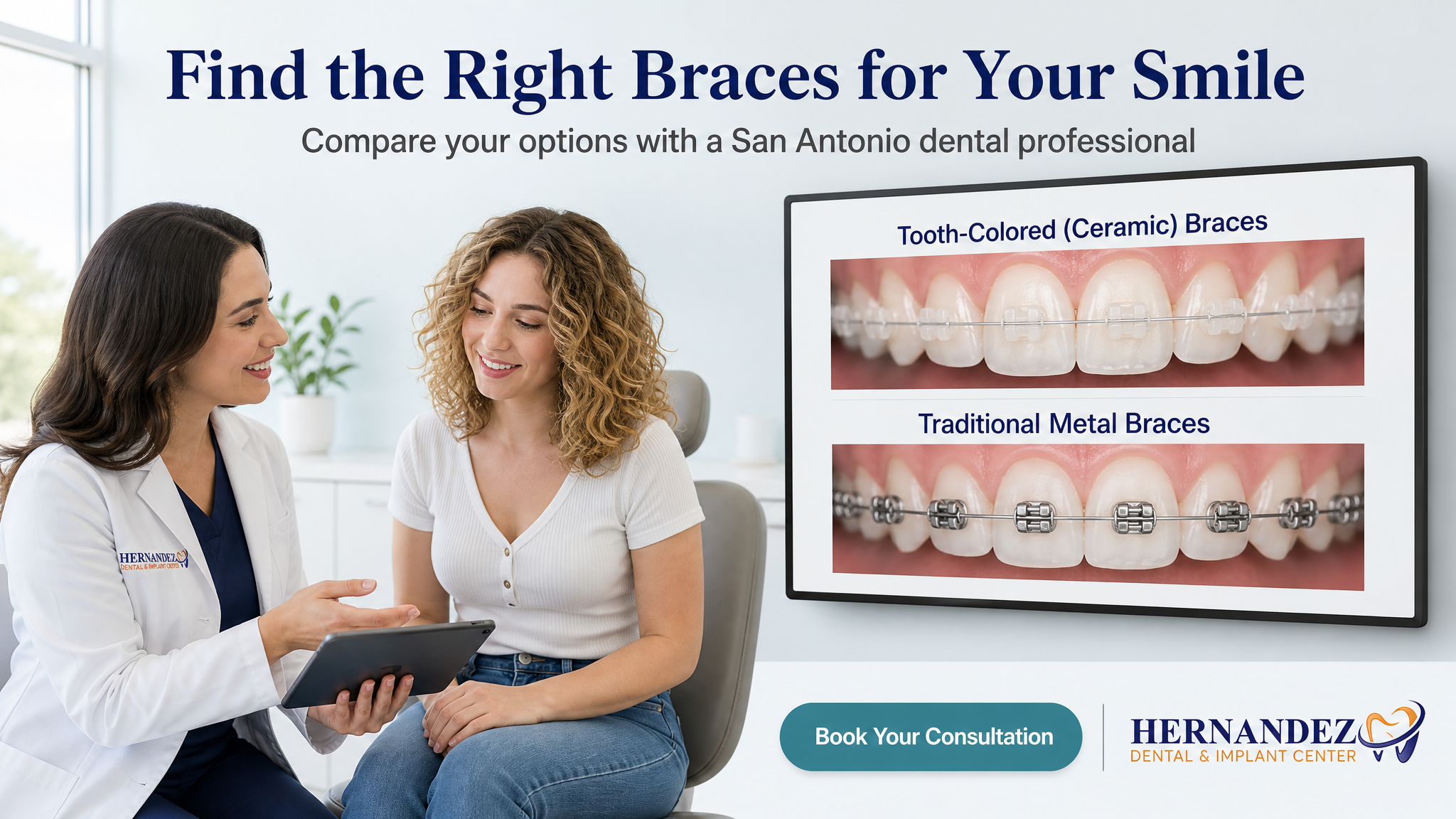
Ceramic or Metal Braces: Which Is Better?
Ceramic braces may be better when having a less noticeable smile during treatment is your highest priority. They provide the familiar reliability of fixed brackets and wires while blending more naturally with your teeth.
Metal braces may be better when strength, affordability and low-maintenance durability matter most. They are highly versatile and may be preferred for more demanding orthodontic movements.
The choice can be summarized simply:
- Choose ceramic braces when you value discretion and are willing to provide extra care.
- Choose metal braces when you value strength, affordability and easier maintenance.
- Schedule an examination when you are unsure which system can safely and effectively address your bite.
Frequently Asked Questions
Do ceramic braces take longer than metal braces?
Not necessarily. Treatment time depends primarily on the complexity of your condition and how your teeth respond. Ceramic braces may sometimes take slightly longer because providers must be careful with the more fragile brackets, but this does not apply equally to every patient.
Do ceramic braces stain?
The ceramic brackets themselves are made to maintain their appearance, but clear elastic ties and other light-colored components may become discolored. Careful brushing and limiting frequent exposure to strongly pigmented foods and drinks can help.
Are ceramic braces more expensive?
Ceramic braces are usually more expensive than metal braces because of the materials used and the aesthetic benefits they provide. Exact fees vary according to treatment complexity, treatment length and clinic policies.
Can ceramic braces treat severe crowding?
Ceramic braces can treat many cases of crowding, but they may not be recommended for every severe or complex condition. Metal braces may be preferred when greater durability or specific force control is required. Your provider must examine your teeth before recommending a bracket type.
Are ceramic braces suitable for teenagers?
Yes, ceramic braces may be suitable for responsible teenagers who want a less noticeable treatment and can follow cleaning and food restrictions. The decision should also consider the teenager’s bite, oral hygiene and risk of bracket damage.
Can adults get ceramic braces?
Yes. Ceramic braces are commonly considered by adults who want fixed orthodontic treatment with a more discreet appearance. Adults can receive effective orthodontic treatment, although individual treatment time depends on their oral health and orthodontic needs.
Can I switch from metal to ceramic braces?
Switching may be possible in certain cases, but it is not always practical or necessary. Changing brackets can involve additional appointments, treatment-plan adjustments and fees. Discuss the advantages and possible costs with your provider before making a change.
Are clear braces the same as clear aligners?
No. Clear or ceramic braces are fixed appliances with brackets and wires. Clear aligners are removable plastic trays that must be worn according to the treatment schedule.
Compare Your Braces Options
You do not have to choose between ceramic and metal braces without professional guidance.
Hernandez Dental & Implant Center provides braces and orthodontic care for patients in San Antonio. During your consultation, the dental team can evaluate your teeth and bite, discuss appropriate treatment options and explain the factors that may affect your treatment cost and timeline.
Schedule your braces consultation today.
Call (210) 533-8191 or visit Hernandez Dental & Implant Center at 1347 Fair Ave, San Antonio, TX 78223 to begin exploring your options.